

How To Clean A Rusty Steel Trap
Dipper, painter or naturalist? Preparing your traps is a big job and there are many methods that work. This is how i experienced north wood trapper does the job.
By Cary Rideout
Photography past Lorain Ebbett-Rideout
One important preseason chore for whatever trapper is preparing traps for the coming campaign. Along with checking chains and how fast traps fire, many trappers likewise stain or color their steel. But how to get the correct hue so the fur is fooled is like most things in the trade — open up to interpretation.
Photograph credit: Lorain Ebbett-Rideout
Old Rusty
So just what is the scientific discipline of steel and stain? Metal, if left untreated, will happily rust and eventually reduce all of that expensive shiny stuff to grit. Rust, every bit the former song says, never sleeps and trappers must be vigilant to go along a weathered heart on steel condition. Light surface rust is actually not a bad fellow and makes certain treatments work better. Pitting is the worst considering it means the culprit has breached the surface and begun to chew in deep.
Rust volition soon weaken steel and put less punch in killer traps, and offer a wily furbearer the chance to piece of work gratuitous from footholds. Rusty steel tin can exist tough to ready, or worse, still effect in poor firing. A little steel wool could remedy surface rust, but concur off the grinders and power sanders please. If you lot can smell hot steel than the tempers are in problem! Oil is a friend of steel, but nigh trappers concur information technology's not the respond for setting time. 10W30 is bound to attract dirt and that'southward when the problem begins. Continue the engine oil in the Ford — not on the #one½.
Blood Fume and Grease
Putting a good color on traps is as old every bit the trade itself and was used as far dorsum as the Center Ages. Some dyes worked while others were best left on the pages of history. Embrace scents were popular and fur trappers used blood or smoking steel with smoldering conifer boughs to supposedly cover all iron or human scent. Can you lot prototype deliberately exposing a trap to any kind of wood fume? Blood coating was recommended, besides, but must have had all sorts of consequences, such as dirt clinging to the canis familiaris or pan and slowing the speed of firing, permit solitary alluring attending to the trap that yous would be trying to hibernate.

Photo credit: Lorain Ebbett-Rideout
Various greases made from wild animal fat renderings also had a share of believers, but how those slicked-upwards traps performed is anyone'due south guess. A liberal blanket of lard would certainly brand for a trap that would slip around and never stay put! No wonder the trapping world grabbed onto logwood fries.
Logwood products put a trap in practiced club, and in conjunction with a thin wax coating, are the traditional coloring treatments withal equally popular equally always. It should be pointed out that logwood liquid requiring no humid is now too available.
Rust? What Rust?
There are trappers who never bother with dye and don't see rust as anything more than, well, rust. They believe that it makes absolutely no divergence and all of the time-consuming cooking is foolishness, since rust is something encountered daily and furbearers aren't suspicious. "Just knock off the rust and so they volition fire and become them set." Hmmm, maybe not quite.
It is true that few of us will ever lucifer wits with fur that hasn't smelled rusty metal. Have you ever had a situation when a replacement foothold wasn't handy and you had to remake with a trap that had rust from exposure? Y'all probably had another grab, and then that lends some validity to the rusty argument. It's tough for a difficult-cadre trap stainer to admit, but in a perfect fix with good attraction, rust is ofttimes overlooked past a curious critter.
What about beavers or otters with footholds and body grips? With water trapping, rust might not be such a trouble since many sets are submerged. With trunk grips, the targets tend to be moving chop-chop and hitting the long triggers with enough strength to fire rusty steel. But, the trouble is that over a season whatsoever water trap is going to get enough of time to rust upwardly. A well-rusted body grip stands out like a black eye in church, and even under water many trappers experience that the run a risk of detection is likewise high, then they prefer to stain their steel.

Photo credit: Lorain Ebbett-Rideout
One other affair that no i tin contend about is the chance that fur could exist marked upwardly, especially in the case of wet, rusty traps. If you tin can see it — a grader with a more disquisitional eye is certainly leap to as well. Some people claim that rust only brushes out of the fur, simply why take the risk of losing money?
Naturalists
For traditional trap dye, Mother Nature provides a host of products for putting a decent stain on steel. Nut hulls, barks and leaves all take qualities that trappers have turned to for generations. A couple of old favorites in the North Wood are hemlock bark and the furry tips of the sumac bush. It takes a quart tin of fine chopped bark for every gallon of h2o, and I eddy it hard for a couple of hours, adding h2o as it steams off. Lower in your traps and gently simmer them until the colour y'all wish is reached. The same goes for the mucilaginous sumac buds. Use a quart can to every gallon of h2o. Sumac can be messy so information technology's a little more clean if you use a fine mesh to proceed things contained.
Photo credit: Lorain Ebbett-Rideout
My early experiments of waxing those products were not satisfactory so I skipped the candle treatment. As far as the remaining scent goes, the traps end up woody with a bit of sugariness that over time mellows away. Another old-time stain is fabricated with a farm's biggest nuisance, alder bark. Use the juicy early leap kind and assemble manner more than you retrieve you will need. The same goes for oak or maple leaves — use plenty — and when simmering take your time. If you are currently using store-bought products it is quite an heart-opener how time-consuming natural ingredients tin can be.
If yous're cleaning crud and rust with a solution of hardwood ashes boiled in water, use plenty and melt it hot and long. Ash humid is a full day in itself, so allow for this when preparing. Endeavour to use clean, fully burned-down ash from maple or birch. The lye water from boiling ashes is caustic and strong, peradventure not as strong every bit muriatic acid, but that stuff can be a tad temperamental. So yous might be better off using lye or its equivalent.
Speaking of lye, sometimes it can exist hard to purchase these days, just there are likewise household products that work fine. I don't like mentioning brand names, just Sani-Flush or anything similar works great.

Photo credit: Lorain Ebbett-Rideout
Traps with rust that looks beyond hope might also be cleaned with vinegar. Non the table stuff, merely the special household cleaning blazon. Submerge the traps in it and bank check several times daily as it'due south a fast worker and might ruin your efforts. Also be enlightened that vinegar-treated steel needs to exist slowly boiled immediately afterward in blistering soda water. Apply half of a box to a gallon and slowly simmer, then rinse and simmer in plain h2o. Heavy-duty cleaning vinegar will eat off the hard rust, only many times a trap that is so far gone is best set aside because dogs, triggers and other parts are generally ruined by extensive rust.
The Big Day
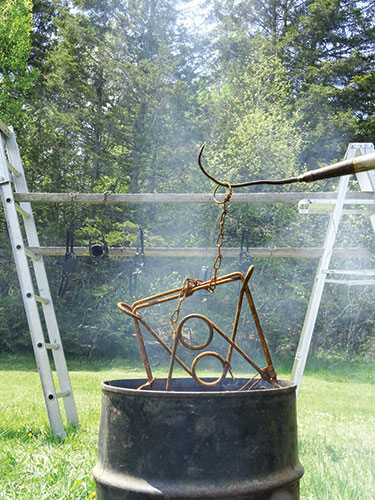
Any trap dipping or cooking job requires room outdoors with no distractions. Depending on the type of colour process chosen you may crave a heat source like a cement-block BBQ or a burn down pit with a heavy grate. A gas camp stove lends a scrap more control then an open fire and with some area'south regulations on open burns, it might be the way that you'll accept to become. Work in the shade with when at that place's no cakewalk that might blow debris into the freshly colored steel as it dries. A couple of step ladders with poles between them works great for good drying. A discarded kid's swing prepare too makes a good drying rack with some welding modifications, or with a chip of carpentry work build your own creation.
Dipping and boiling requires big, deep containers. For petroleum dipping a couple of large, wide dish basins, rubber gauntlets and a two-inch paint brush are low-cost reusable investments. Logwood humid requires heavy gauge kettles capable of treatment high heat. Used canning kettles or cast iron Dutch ovens piece of work excellent equally well. Get several kettles so that you lot aren't stuck with one container doing all of the piece of work.
During any coloring job with prolonged cooking, always keep a length of concatenation in the bottom of the kettles to protect traps because directly heat tin ruin their temper. For adding or removing traps from boiling kettles, utilize a long wood pole with a hook, and then leave everything hanging for a day or more to cure. Sometimes if traps are tacky they might require more than air/lord's day drying, then exist aware of pelting or dusty conditions.
Professionals make clean and sanitize all digging tools, bondage and pretty much anything that comes in contact with traps. Information technology might seem overkill, but the pros have the success to support the effort. Ane thing that I never dye are snares, only storing them in sacks full of hemlock boughs. Practice I suffer refusals? Probably. But all of the locks, loops and wires, at least to me, are places for dye to clog upwardly and slow their firing time. Only, if you lot but apply baking soda or some other handling then proceed doing so.
If possible, store the dry out and treated traps in like-size bundles in a chemical-gratuitous expanse. A wood shed or an old befouled could piece of work every bit long every bit it'southward prophylactic from pilferage and has no fuel or mechanism smells. Keep trap sizes separated and easy to attain because once you are trapping you'll accept no time to sort things.
If you prefer to store treated steel in containers then lay a good bundle of hemlock or spruce boughs in the bottom, but go along the pitch dripping end away from traps. Put in layers of traps and green boughs to fill up the container, secure the chapeau and set in a dry corner with no disturbance. Waxed steel should exist separated from unwaxed. I adopt big plastic tubs with snap lids or the double lid shipping totes that delivery companies use. Thoroughly wash all condom and plastic containers with soapy water, and when dry out give them a week of seasoning with evergreen boughs to have on a mellow scent. If it all audio like a lot of piece of work it is, but treating steel is piece of work so why make a mess of things with poor storage?
Wax and Weather
Wax is something that causes controversy, with believers always waxing, and everybody else never bothering. Store-bought trap wax is slick stuff, but follow the instructions for a quality finish. Early on my waxing was pretty chaotic with wax flaking and falling off, or and then thick it encased the trap, and it took some learning. Nowadays when I wax it is done in a small kettle one trap at a time with wax floating on hot water. A campsite stove does the all-time chore keeping the correct rut so things don't flame up.

Photo credit: Lorain Ebbett-Rideout
Canning wax will adhere very well and lasts long, likewise. Paste floor wax sort of works and common liquid flooring wax coats nicely, but is it e'er fast firing. Information technology'due south just as tough on fingers equally information technology is on fur — believe me. I steer clear of calculation anything to wax, such as a dab of spruce glue, pine rosin or beeswax. Wax is fine for longsprings or coils but not for body grips. Mind to me, I am trying to go on y'all from a bad injury. DON'T WAX Torso GRIP TRAPS. They will fire equally fast equally you set them and take hold of your hands but equally apace.
Weather conditions can have a disastrous consequence on a staining functioning so I watch the skies religiously before commencement. Air pressure, humidity and common cold are all equally troublesome. Loftier humidity affects both how metallic is coated and the drying quality, particularly with petroleum dip products. In the North Woods, belatedly September is about perfect with bone-dry air and rain-costless days the norm. Be aware of the neighbors doing any yard work like burning trash and leaves, or farm operations or pest spraying going on. Trouble can migrate in from some surprising distances and a poultry operation burning feathers is a disaster on trap dye solar day.
Gassy Choices
Petroleum dip products require the biggest outlay of greenbacks because they use fuel, and with the corn additives now common you must find a source of premium corn-free fuel. This is why some dippers at present use camp stove gas. Both fuels aren't cheap and neither is the dip, which comes in brown, white and deep black. Dip provides a hard, long-lasting finish good for 3 years if properly stale — which is the key to whatever dipping.

Photo credit: Lorain Ebbett-Rideout
I like to sparse down the gas-dip ratio for a mix that seems to comprehend improve. Apply a paint brush to embrace everywhere evenly, and work slowly. Speed is but the product'southward proper name — not the objective. Once stained, hang them all in the shade with plenty of infinite around them. A shady spot keeps off the directly sun and night dews, both of which can affect the curing process. If they seem tacky that ways that you lot demand more fuel and longer dry times. Merely similar logwood or any other product, it needs to be practical correctly with proper drying.
Another selection for treating traps is the graffiti artist'south friend, the trusty spray bomb or aerosol tin can of paint. Applying a glaze of spray black paint is fast and costs very lilliputian in comparing to other treatments. Get a skillful, quality rust production, but be careful. Weather conditions and grit can make a elementary chore a bother. Ready a work area out of the wind and not in direct sunlight. Less paint is fine and let a couple of traps cure until you go your method down to a science. Whatsoever paint product should be a apartment or matte finish, with no shiny stuff. It's tough enough to proceed the fur from being suspicious — and a shiny trap is not going to help.
Avoiding Dye-Day Disasters
Care and caution are necessary around any dye work. Make sure that your work area is clutter complimentary and then that y'all don't trip into the fire or knock the camp stove over. Watch that your fire is not a iii-alarm blaze because high flames don't throw heat. A pile of ruddy hot coals practise the best cooking and plenty of wrist-size hardwood will become the heat congenital up quickly. Continue your fuel forest or gas well abroad from the flames and stick your axe into a cake and then that you don't stumble over information technology.
Never use gas or any petroleum nigh open fire — and then don't mix methods on the aforementioned mean solar day. Logwood work today, petroleum dip tomorrow. Speaking of burn down, accept a decent size extinguisher handy and a couple pails of water to douse whatsoever problems. Hot water can scald instantly and ruin your trapping season in a heartbeat.
Be smart near hot wax likewise, since wax can become a flaming disaster if overheated. When treatment boiling water and traps, wear thick, clean gloves and use a stout wood pole to piece of work traps that is long enough to exist clear of the burn down. Wearing apparel with long sleeves and pants and don't await similar you're on the beach — then no flip-flops. Above all, get dull and pay attention to the fire. Any burn down or other injury is ane besides many.
Keeping the tools of any merchandise in good status is a smart do and traps need equal care to perform well. Continue your steel clean, treated and firing fast then that when old Iii Toes shows upwards you'll be set.
Mousing Play a joke on Takes a Nose Dive – Trapper & Predator Caller


Source: https://www.trappermag.com/uncategorized/how-to-treat-your-steel-traps
Posted by: worshammarithere.blogspot.com
0 Response to "How To Clean A Rusty Steel Trap"
Post a Comment